With my coffee and phone in hand, I sit down with my toddler and eight-month-old. The morning sun pours into the living room as my son scans the floor for new items to put in his mouth and my daughter plays games on her tablet, giving me about 20 minutes of peace to read the morning news. My email is on the light side this morning, so I switch to Facebook with the intention to see updates from friends or family and funny videos. It’s never really gone that way though. Since I set up my first profile at 12 years old, I’ve come across violent content and posts from friends and family have become less visible. It seems as though the algorithm has a personal vendetta against me. I scroll past an influencer trying to convince me that I have psychologically scarred my children 10 different ways since I woke up 30 minutes ago. Every other post or reel is of the latest national divisive news story. I come across another true and rare story of a children’s life coming to a violent end, no matter how often I report not wanting to see violent content in my feed.
“Hey, mama?”
“What!?” I flinch at the snap I hear in my own voice, my queue that it’s time to stop doomscrolling.
UC San Diego Today defines doomscrolling as “a tendency to endlessly consume news and content that heightens feelings of anxiety, sadness or anger.” In the same article, Susan Tapert, Ph.D., a distinguished professor of psychiatry at UC San Diego School of Medicine suggests that doomscrolling is hard to resist because alarming news gets our brains stress signals firing to keep checking for more threats, which is satisfied by more doomscrolling. Every time we collect more information, our brain then releases the rewarding brain chemical, dopamine, creating a cycle that’s hard to snap out of. I don’t believe social media itself is bad, I think the idea is genius, and the current designs are not living up to social medias full potential. I’ve deleted my accounts numerous times to get away from doomscrolling but have always come back for friend and family updates, marketplace and local groups. In fact, a 2026 Gallup report found that moderate social media users reported fewer negative feelings than high users and more positive experiences than low users. Even though the positive experiences are there, something about the algorithm also provides an experience that feels too familiar to nicotine. The irritable and dazed state I’m left in for a few moments shortly after scrolling feels like I’m subjecting my family to secondhand smoke. And every time I try to quit, I can’t stay away for long. After further research, I realized there is a huge group all over the world that has been calling out Big Tech for following Big Tobaccos old playbook, making me feel like I’ve arrived not-so-fashionably late to a party. However, as of 2026, 201 million people globally are impacted by social media addiction, so at least I’m not the last to arrive!
A Brief History of Cigarettes
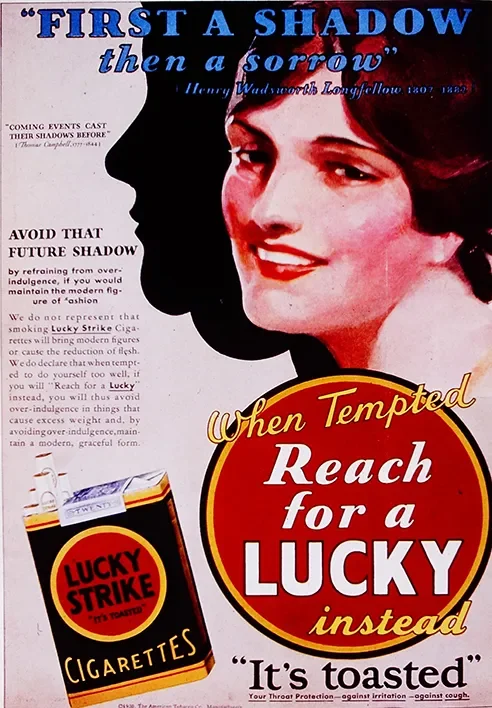
Before I compare the algorithm to cigarettes, let me explain how tobacco became legally and socially unacceptable. Way back in the late 1600’s the public was noticing how difficult it was to quit using tobacco. European countries began linking lip and throat cancer to tobacco use. As cigarette production advanced, they became more affordable. Because affordability might attract children to use tobacco products, the first age restriction on tobacco sales was set in New Jersey in 1883. This was the beginning of a cigarette ban including children and adults in 15 different states and more states were considering following suit. Cigarette sales skyrocketed at this time and every ban eventually collapsed. When WW1 broke out the army made cigarettes part of their rations, supplied by the government. Big tobacco companies took advantage of this opportunity, handing out cigarettes by the millions to servicemen, building their customer base and marking the cigarette as a symbol of strength, bravery and patriotism. Charites like the YMCA, Salvation Army and The Red Cross even ran tobacco funds to ship to the front lines. The soldiers came home after WW1 smoking, but the Big Tobacco companies wanted more customers. It was still frowned upon for women to publicly smoke in the late 1920’s so The American Tobacco Company manufactured a stunt where they hired women to smoke in New York’s Easter Sunday Parade, marking cigarettes as “Torches of Freedom” for women. It wasn’t until 1964 when the U.S. Surgeon General made his first report on smoking and health with 42% of American adult smokers. In 1986 the U.S. Surgeon General made his first report on the effects of secondhand smoke; the moment society began to understand that the independent choice to smoke provided deadly consequences to those around them. By 2014 American adult smokers was brought down to 18%.
Social Media’s Cigarette Moment
In 2013 a Google employee named Tristen Harris submitted a presentation to the company titled A Call to Minimize Distraction and Respect Users’ Attention, which shared his concerns on the company negatively impacting users’ health by harvesting their attention. The presentation was shared among thousands of Google employees and reached the CEO, but it was ultimately ignored. In 2017, former Facebook president Sean Parker shared at an Axios event how himself and other cofounders designed the platform to exploit human psychology and keep users on the site for as long as possible. In 2021, Facebook whistleblower Frances Haugen stood before the senate with documents from Facebooks own internal reports finding "we make body image issues worse for one in three teen girls," and “among teens who had suicidal thoughts, 13% of British users and 6% of American users traced the desire to kill themselves to Instagram”. Unfortunately, social media scrutiny was redirected in 2021 when Twitter permanently banned Trump from the platform due to concerns of his posts enticing violence while protestors stormed the capital. This event sparked debate on the limits of freedom of speech on social media. So, in 2022 Trump launched his platform, Truth Social, and Elon Musk bought Twitter, now called X, and reinstated banned accounts which symbolized these platforms as spaces of free speech instead of products under scrutiny. In May 2023 the U.S. Surgeon General placed an advisory on social media for harming the mental health of children and adolescence. In 2023 Meta was finally sued by 33 states for addictive designs to maximize children’s attention, using manipulative features while telling the public their platforms were safe for children, lacked transparency in user harm and refusing to change their harmful features. In a 2024 interview NPR had with U.S. Surgeon General Vivek Murthy, he explains that placing a label on social media, similar to the one found on a cigarette pack, could have a positive impact. Since then, a few states have pushed for warning labels, but congress has been quiet on the matter.
The Cost While We Wait For Action
The first price we have paid for social media is a healthy, social childhood. I came across a book by Jonathan Haidt, a social psychologist who has been studying the link between teen mental health decline and social media, called The Anxious Generation (affiliate link). In his book, Haidt helps us notice what he calls The Great Rewiring of childhood where parents no longer feel safe letting their children out of sight to maintain their own social lives until the streetlights come on, which has placed their social lives and their mental health in the hands of the owners of the platforms. He also points out that even if we try to slowly fix this issue and get kids back outside with their friends, parents across the country are facing charges for “child neglect” when their children are seen outdoors without an adult present due to how rare it has become. Another price we are paying for social media is our democracy. In the book Breaking the Social Media Prism (affiliate link) written by Chris Bail, professor of sociology and public policy and director of the Polarization Lab at Duke University, explains how these platforms move beyond echo chambers and the algorithm rewards loud extremists, creating environments for us to see caricatures of the left and right. This process can make users feel they are living in a world of extremists, making them double down and slowly become more extreme themselves. In reality, most of us land in the messy middle of the political spectrum.
What Can We Do?
As I said in the beginning, I don’t believe banning social media is the answer. History tells us that is not a method that works and there is plenty of value found in the platforms like brand awareness for business owners, global connectivity, cultural exchange, entertainment, inspiration and even education. In 2025 Australia banned social media from users under 16 years of age but the ban seems to be completely failing from even keeping young users off. Another study found the same U-shaped results I shared earlier among young users where high use is linked to distress, while no use is linked with missed connection. Something we can do is support technology free or limited spaces, starting with a complete phone ban at school. 74% of teachers report cellphone distractions are a major problem for students in class. As of October 2026, 44 states and DC have placed cell phone policies in public schools, however over half of teens report using their phones anyway, with an average phone use of an hour and half during the school day. All humans need phone free zones and there is no room for addictive social media designs in classrooms with our children. We can make schools bell to bell phone free zones by contacting our local schools (this letter prompt needs updating but it’s a helpful start for those of us who haven’t been writing too many fancy letters lately). We can also make this happen by modeling our own phone free spaces to our kids. It took my husband and I quite a bit of time to turn our mornings and family breakfast into a tv and phone free zone, but it’s become our favorite part of the day. More than half of teens aren’t getting enough sleep, so the bedroom is another great space to make a phone free zone. Another thing we can do is be mindful of our behavior on social media. The algorithm doesn’t know a good comment from a bad one. Don’t give your rage and attention to content you want to see less of. Watch out for feedback loops and rabbit holes. The algorithm doesn’t know the difference between being sad tonight or being chronically depressed. Lingering on sad videos, mad-at-your spouse content or conspiracy theories will flood your feed with that same content daily until your focus shifts away from it. Remind yourself to check for accuracy before sharing a news story to keep inaccurate information from circulating. Until we can get a warning label on these platforms to remind us to moderate ourselves and be careful about what we come across, we must warn ourselves every time we open the app.
I hope you enjoyed today’s read. I have been an off and on heavy social media user since I was preteen and learning more about the platforms have helped me fix my feed and reduce my time spent doomscrolling. I think I’m much happier when I just visit the platforms briefly a few times a week. My home starts to look nicer, I don’t as feel self-conscious or paranoid about my children’s safety and the world still feels like a dumpster fire but it’s easier to find the tools to contain the fire when we’re not so distracted. This post inspired the page Unsubscribe From Doomslop if you want to check it out. It’s just some places on the internet that I feel want to inform me and not harvest my attention. What did you think of today’s topic? Have you tried stepping away from social media and felt better? Or do you think I’ve stumbled across a wild conspiracy? Send me a message on the contact page, I’d love to hear from you. If you liked what you read and want more of it, scroll down and subscribe to be notified of my work by email. I hope are having the season you deserve. Navigate carefully. Until the next echo, LeAnn.